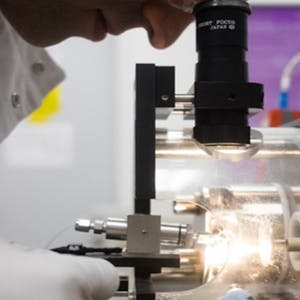
This course is about how the brain creates our sense of spatial location from a variety of sensory and motor sources, and how this spatial sense in turn shapes our cognitive abilities. Knowing where things are is effortless. But “under the hood,” your brain must figure out even the simplest of details about the world around you and your position in it. Recognizing your mother, finding your phone, going to the grocery store, playing the banjo – these require careful sleuthing and coordination across different sensory and motor domains. This course traces the brain’s detective work to create this sense of space and argues that the brain’s spatial focus permeates our cognitive abilities, affecting the way we think and remember. The material in this course is based on a book I've written for a general audience. The book is called "Making Space: How the Brain Knows Where Things Are", and is available from Amazon, Barnes and Noble, or directly from Harvard University Press. The course material overlaps with classes on perception or systems neuroscience, and can be taken either before or after such classes. Dr. Jennifer M. Groh, Ph.D. Professor Psychology & Neuroscience; Neurobiology Duke University www.duke.edu/~jmgroh Jennifer M. Groh is interested in how the brain process spatial information in different sensory systems, and how the brain's spatial codes influence other aspects of cognition. She is the author of a recent book entitled "Making Space: How the Brain Knows Where Things Are" (Harvard University Press, fall 2014). Much of her research concerns differences in how the visual and auditory systems encode location, and how vision influences hearing. Her laboratory has demonstrated that neurons in auditory brain regions are sometimes responsive not just to what we hear but also to what direction we are looking and what visual stimuli we can see. These surprising findings challenge the prevailing assumption that the brain’s sensory pathways remain separate and distinct from each other at early stages, and suggest a mechanism for such multi-sensory interactions as lip-reading and ventriloquism (the capture of perceived sound location by a plausible nearby visual stimulus). Dr. Groh has been a professor at Duke University since 2006. She received her undergraduate degree in biology from Princeton University in 1988 before studying neuroscience at the University of Michigan (Master’s, 1990), the University of Pennsylvania (Ph.D., 1993), and Stanford University (postdoctoral, 1994-1997). Dr. Groh has been teaching undergraduate classes on the neural basis of perception and memory for over fifteen years. She is presently a faculty member at the Center for Cognitive Neuroscience and the Duke Institute for Brain Sciences at Duke University. She also holds appointments in the Departments of Neurobiology and Psychology & Neuroscience at Duke. Dr. Groh’s research has been supported by a variety of sources including the John S. Guggenheim Foundation, the National Institutes of Health, the National Science Foundation, and the Office of Naval Research Young Investigator Program, the McKnight Endowment Fund for Neuroscience, the John Merck Scholars Program, the EJLB Foundation, the Alfred P. Sloan Foundation, the Whitehall Foundation, and the National Organization for Hearing Research.
CERTIFICATEKatılım Sertifikası
FORMAT100% Online
DURATIONSelf-paced
What you'll learn
Sensory Systems Analysis
Spatial Analysis
Neurology
Psychology
Coordination
Experimentation
Anatomy
Details
ProviderDuke University
TypeCourse
CategoryHealth & Wellness
LanguageEnglish (Türkçe Altyazılı)
Öğrenenlerimiz ne diyor?
Türkiye'nin yüz akı üniversitelerince hazırlanan; akademik doyuruculuğa sahip eğitim içeriklerinin, etkileşimli videolarla bir araya getirildiği bir üniversiteden eğitim almak istiyorsanız doğru yerdesiniz.
Ramazan Bölükbaşı
Çok yoğun programı olan öğrenciler için büyük bir fırsat. Bir şeylerin gelişmesi değişmesi için çabalamalıyız.
Melis Gülsar
Hızlı desteği ve üst düzey hizmeti ile Campus Online ve Sosyal Medya Sertifika Programı hizmeti sağlayan Adnan Menderes Üniversitesine sonsuz teşekkürlerimi sunuyorum.
We use cookies to improve your experience and show you courses that suit you.
Cookie policy
Customize cookie preferences
We use cookies to help you navigate the site and to perform certain functions. You can find a detailed description of the relevant cookies under each consent category.
Cookies classified as "Strictly necessary" are stored in your browser because they are required for the basic functions of the site.
›Strictly necessaryAlways active
Required for basic functions such as sign in, cart and security; cannot be turned off.
›Functional
Will be used for features such as live chat, the AI chat assistant and embedded video. These features are not live yet; once added, they work only if you consent to this category.
›Analytics
Helps us understand which pages are useful (Google Analytics). It does not target you personally.
›Performance
Cookies that may be used to monitor page speed and technical performance. We currently use no active cookies in this category.
›Marketing
Lets us show more relevant course ads to you and people with similar interests (Meta, Google Ads); the co_utm cookie, which remembers which campaign you came from, is also in this category.
Log in or sign up
Your email or phone is enough, no password. We will send you a code.

 Ramazan Bölükbaşı
 Melis Gülsar
 Nazif Bayram